
Across the water sector, regulatory expectations are increasing.
Utilities are being asked to provide greater transparency around investment decisions, demonstrate stronger links between expenditure and customer outcomes, and justify increasingly significant capital and operational investment programs.
At the same time, regulators, customers and stakeholders are demanding greater confidence that proposed investments represent the right solution, at the right time, for the right reasons.
The challenge for many organisations is that regulatory submissions are often viewed as a discrete activity – something that happens in the lead-up to a pricing review or regulatory determination.
In reality, the strongest submissions are built long before the regulatory process begins.
They are the product of mature asset management systems, robust governance frameworks and an organisation-wide understanding of how asset performance, risk and investment decisions are connected.
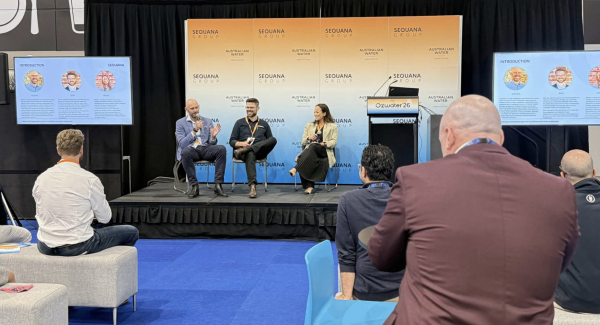
This was the focus of Sequana Group’s Ozwater 2026 panel discussion, Linking Asset Management Maturity to Stronger Regulatory Submissions, featuring Michael Mitchell (General Manager – Asset Management, IPS, a Sequana Company) and Rhys Anderson (Associate Director – Water Strategy & Growth, Sequana Group), facilitated by Misaki Nakamura (Senior Project Manager, Sequana Group).
The discussion explored how asset management maturity enables utilities to build stronger investment cases, improve regulatory confidence and ultimately deliver better outcomes for customers and communities.
Why Asset Management Maturity Matters More Than Ever
The relationship between asset management and regulatory performance has never been more important.
Regulators are increasingly looking beyond project-level justifications and seeking evidence that organisations have mature systems and processes supporting their investment decisions.
Increasingly, regulators are also expecting organisations to demonstrate a Total Expenditure (TOTEX) mindset when evaluating investment options. Rather than assessing capital expenditure (CAPEX) and operational expenditure (OPEX) in isolation, mature organisations consider the total lifecycle cost of assets and services. This approach encourages decision-makers to select solutions that deliver the greatest long-term value, balancing upfront investment, operating costs, risk and customer outcomes over the life of the asset.
Questions are no longer limited to:
“What are you proposing to invest in?”
They increasingly include:
- How was the need identified?
- What evidence supports the investment?
- What risks are being addressed?
- How were alternatives assessed?
- What customer outcomes will be achieved?
- How will benefits be measured?
Answering these questions convincingly requires more than technical analysis.
It requires a mature asset management system capable of providing a clear line of sight from asset performance and risk through to investment need and customer value.
What Does a Mature Asset Management Organisation Look Like?
One of the panel’s central discussions focused on the characteristics of mature asset management organisations.
While maturity can be assessed in different ways, common characteristics typically include:
- Clear governance and accountability structures
• Defined asset management policies and objectives
• Robust asset information and data management systems
• Consistent decision-making frameworks
• Strong risk management processes
• Integrated planning across operational, tactical and strategic horizons
• Continuous improvement mechanisms
• Alignment between organisational objectives and asset investment decisions
Importantly, maturity is not simply about documentation or compliance.
It is about creating confidence that investment decisions are informed, repeatable, transparent and aligned with organisational objectives.
Creating the Line of Sight Between Risk and Investment
A recurring theme throughout the discussion was the importance of establishing a clear line of sight between: Asset Performance → Risk → Investment Need → Customer Outcomes
This linkage is often where regulatory submissions succeed or fail.
When organisations can clearly demonstrate how deteriorating asset performance creates risk, how that risk affects service outcomes, and how proposed investments mitigate those risks, decision-making becomes significantly more transparent.
A mature asset management approach also supports more effective TOTEX decision-making. By understanding the relationship between asset condition, risk, performance and long-term service outcomes, organisations can assess a broader range of intervention options. In many cases, the optimal solution may not be the one with the lowest upfront capital cost or the lowest annual operating cost, but the one that delivers the lowest overall lifecycle cost while maintaining service levels and managing risk appropriately.
Conversely, where asset information is incomplete, governance processes are inconsistent, or risk assessments are poorly integrated into planning processes, investment justifications become more difficult to defend.
Mature organisations create confidence because they can clearly explain not only what they intend to do, but why they intend to do it.
Governance as a Strategic Enabler
Governance is often viewed as an administrative requirement.
In practice, it is one of the strongest indicators of asset management maturity.
Strong governance frameworks ensure:
- Decisions are made consistently
- Roles and responsibilities are clear
- Risks are understood and managed
- Investments are prioritised objectively
- Strategic objectives are translated into actionable plans
- Capital and operational investment decisions are evaluated through a whole-of-life TOTEX lens
This capability is becoming increasingly important as regulators seek assurance that organisations are selecting the most efficient solutions over the long term. Strong governance frameworks help ensure that investment decisions are based on total value and lifecycle outcomes rather than short-term budget considerations.
Most importantly, governance creates confidence.
Confidence internally for executives and boards.
Confidence externally for regulators, customers and stakeholders.
And confidence that investment decisions will continue to deliver value over the long term.
Preparing for the Future Regulatory Environment
As regulatory scrutiny continues to increase, the relationship between asset management maturity and regulatory success will only become stronger.
Utilities that can demonstrate:
- Robust governance
- Reliable asset information
- Transparent decision-making
- Clear risk-based prioritisation
- Evidence-based whole-of-life TOTEX decision-making
- Strong strategic alignment
will be better positioned to secure funding, justify investment programs and build trust with regulators and customers alike.
As regulatory frameworks continue to evolve, organisations that can demonstrate a clear and repeatable approach to TOTEX assessment will be better positioned to justify investment programs. The ability to show that alternatives have been evaluated based on total lifecycle cost, risk and customer outcomes provides regulators with greater confidence that expenditure proposals represent the most efficient and sustainable solution.
Those capabilities cannot be developed in the months before a regulatory submission.
They are built over time through disciplined asset management practice.
The Real Outcome
Ultimately, stronger regulatory submissions are not the end goal.
They are a by-product of stronger organisations.
When asset management systems are mature, organisations gain greater confidence in investment decisions, regulators gain greater confidence in expenditure proposals, and communities gain greater confidence that infrastructure investments will deliver long-term value.
The organisations that succeed in future regulatory environments will be those that can connect strategy, asset performance, risk, investment and whole-of-life value into a single, coherent story.
Because the strongest submissions are not simply well-written.
They are well-founded.
Get in touch to discuss how Sequana can support you with Asset Management or to learn more about our Asset Management Best Practice Guide. Reach out to michael.mitchell@ipsorg.com.au