

By Toby Chalmers, General Manager – Engineering, IPS Infrastructure Project Solutions), A Sequana Company
Most Australians assume access to safe drinking water is universal.
Turn on the tap. Safe water flows.
It’s one of the fundamental expectations of modern life.
Yet over the past two years, my work with remote and regional Queensland communities has reinforced a confronting reality: for some Australians, water security remains far more fragile than most people realise.
At IPS, a Sequana Company, we’ve worked alongside communities facing prolonged challenges with their drinking water systems. What stood out wasn’t that the technical issues were unique. It was the same patterns that kept emerging, regardless of the community.
Aging infrastructure. Reactive maintenance. Limited operational capacity. Workforce shortages. Funding that often arrives after systems fail rather than before.
Most importantly, communities living with risks that would be considered unacceptable in metropolitan Australia.
The experience prompted a question I believe our industry needs to ask more often: If safe drinking water is essential to community health and wellbeing, why does it remain so fragile in some Australian communities?
The Problem Isn’t Just Infrastructure
Our investigations focused on two Queensland communities with very different water supply systems.
One relied on conventional surface water treatment infrastructure. The other depended on a complex network of bores, river extraction systems and long-distance transfer infrastructure.
Initially, the issues appeared largely technical. Treatment performance challenges. Aging assets. Limited automation. Incomplete system visibility.
But as our work progressed, it became clear that these individual issues were rarely the root cause.
Instead, they reflected broader systemic conditions that had developed over many years.
Infrastructure had often been repaired incrementally, in response to system failure, rather than proactively renewed to provide ongoing water security. Documentation was incomplete. Preventive maintenance had been constrained by resources. Operators were managing increasingly complex systems with limited support.
The infrastructure was still functioning, but often under sustained stress.
The technical issues were real. They simply weren’t the whole story.
Water Security Is a Public Health Issue
When water systems become unreliable, the consequences extend far beyond engineering performance.
They affect public health, community confidence, healthcare delivery, education, economic participation and overall wellbeing.
A prolonged boil water notice is not simply an operational event. It represents a loss of confidence in an essential public service.
For many remote communities, these challenges can persist for extended periods. What would be viewed as an unacceptable disruption elsewhere can gradually become normalised.
As an industry, we should ask ourselves whether we have become too comfortable accepting levels of water security risk in remote communities that would never be tolerated in major population centres.
The Cost of Waiting for Failure
One of the strongest lessons from this work was the value of early intervention.
Across both communities, relatively modest investments delivered meaningful improvements in reliability and operational performance. Improvements to monitoring, controls, process optimisation, documentation, maintenance planning and operator support helped reduce risk before major capital projects became necessary.
Just as importantly, they generated the evidence required to support larger funding applications and long-term infrastructure renewal programs.
Collectively, this work contributed to funding pathways exceeding $60 million for future water security improvements.
The lesson is simple.
Preventative investment delivers disproportionate value.
Yet many funding frameworks remain largely reactive. Funding often becomes available after a system has failed, rather than when early intervention could prevent that failure from occurring.
If our goal is resilience, we need to invest in resilience before a crisis emerges.
The Infrastructure We Talk About Least
Perhaps the most important insight from this work had nothing to do with treatment plants, pumps or pipelines.
It was people.
Across every community we worked with, operators were performing extraordinary roles under challenging circumstances.
Many were responsible not only for drinking water systems but also wastewater services, waste management, fleet operations, emergency response and broader infrastructure responsibilities.
These individuals are not simply water operators.
They are system operators.
Yet the capability frameworks supporting these roles have not always evolved at the same pace as the infrastructure they manage.
As water systems become increasingly dependent on automation and digital, operator responsibilities continue to expand.
Access to training, mentoring and specialist support, however, remains inconsistent.
This raises a critical question.
Why do we often treat operator capability as an operational expense when it is fundamentally part of the infrastructure system itself?
Even the most advanced treatment plant cannot deliver safe drinking water without skilled people operating and maintaining it.
Equity Requires More Than Capital Investment
One of the most challenging reflections from this work is that infrastructure inequality is often a visible symptom of broader structural inequity.
Water security is influenced by infrastructure condition, funding models, workforce capability, access to specialist support, asset management maturity, geographic isolation and long-term planning capability.
Addressing only one of these factors will rarely deliver lasting outcomes.
The sector has become increasingly effective at funding infrastructure projects. The next challenge is ensuring we invest with equal intent in resilience, capability and preventative maintenance.
A Question for Our Industry
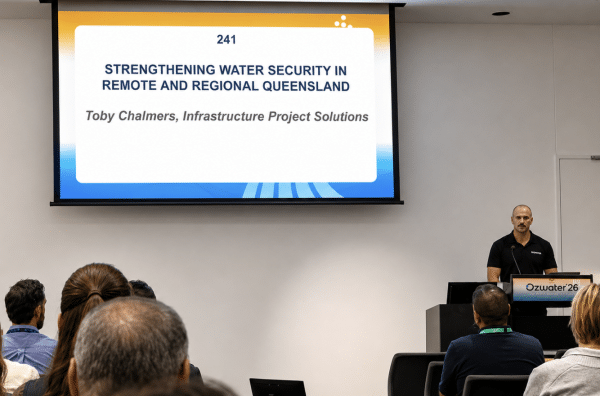
At Ozwater, I posed a simple question: “If safe drinking water is considered universal in Australia, why do some remote communities still experience prolonged water security challenges?”
It is not a criticism.
It is an invitation.
An invitation to think differently about how we define water security.
An invitation to recognise operator capability as critical infrastructure.
An invitation to move from reactive investment towards preventative resilience.
Ultimately, water security is not only an engineering challenge.
It is a public health challenge.
It is a community challenge.
And it is an equity challenge.
Australia has the technical expertise, operational knowledge and industry capability required to address these issues.
The question is whether we are prepared to tackle the structural causes, not just the technical symptoms.
Because safe drinking water should not depend on postcode.
And if equity is truly one of our sector’s values, it must be reflected not only in what we build, but in how we fund, operate and support the systems communities rely upon every day.